
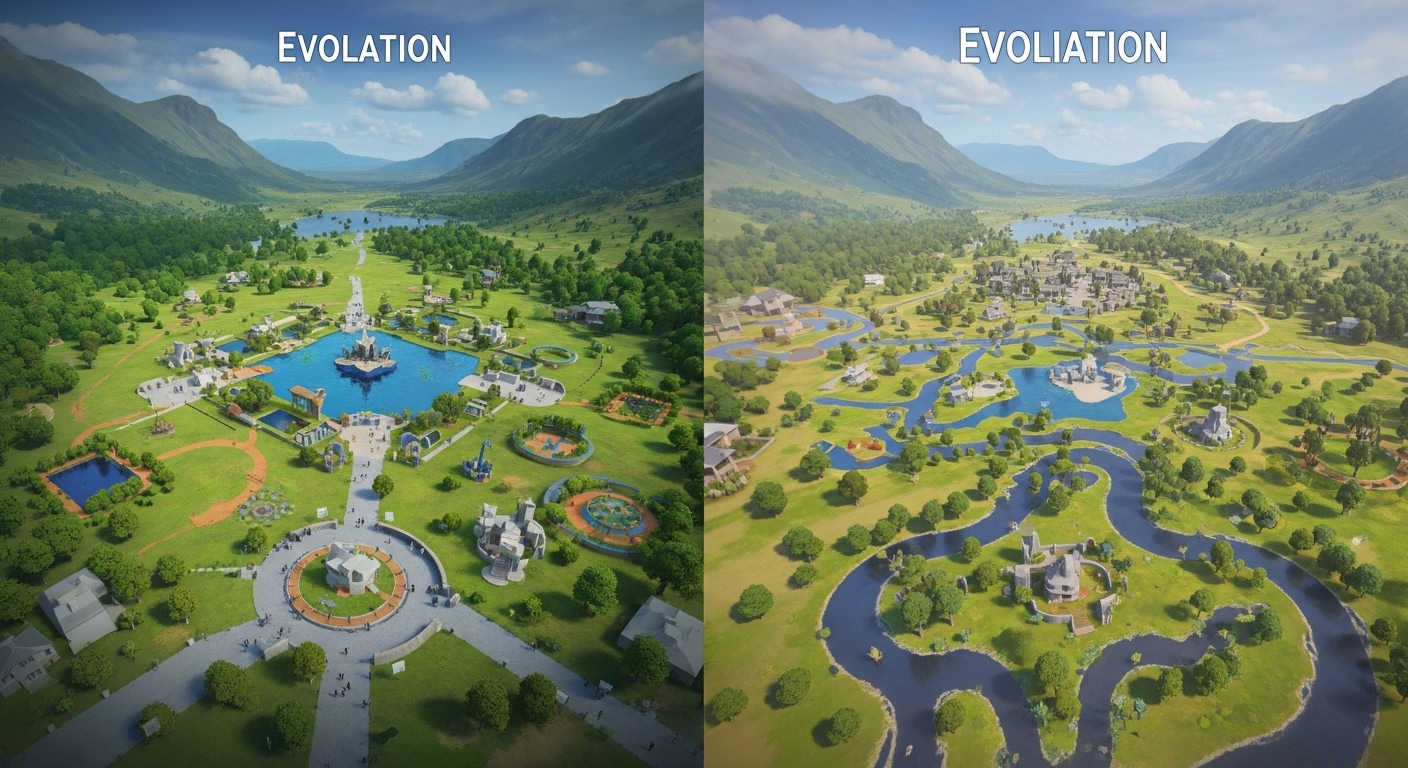
Introduction to Open World Games
Video games have undergone immense transformations over the past few decades, and one of the most significant innovations has been the rise of open world games. Unlike linear games that confine players to specific paths and predetermined outcomes, open world games create expansive virtual environments that allow players to explore freely, make choices, and interact with the world in countless ways. The concept has revolutionized gaming by providing freedom, immersion, and depth, turning digital landscapes into living, breathing universes. This evolution did not happen overnight; it has been the result of decades of technological advancements, creative visions, and changing player expectations. To understand where open world games stand today, it is essential to trace their journey from the earliest experiments to the modern masterpieces that dominate the industry.
The Early Foundations of Open World Concepts
The idea of an open world in gaming began long before advanced 3D engines or modern consoles existed. In the 1980s, developers experimented with creating games that gave players more control over exploration rather than forcing them into linear levels. One of the earliest examples was Adventure on the Atari 2600, which introduced a rudimentary but significant sense of freedom. Players could navigate between different screens, search for objects, and solve puzzles without being forced along a strict path. Similarly, text-based games like Zork also gave a sense of openness, allowing players to type commands and explore virtual spaces in ways that felt unrestricted for the time. Although these experiences lacked the graphical depth of later titles, they laid the groundwork for what open world games could become.
The Rise of Role-Playing Games in the 1980s and 1990s
As computer technology advanced, role-playing games (RPGs) became the genre most associated with expansive worlds. Titles like Ultima and The Elder Scrolls: Arena introduced vast maps filled with towns, dungeons, and landscapes to explore. These games emphasized player choice, allowing decisions that influenced the story or gameplay style. In Japan, franchises like Dragon Quest and Final Fantasy began to push RPGs into more narrative-driven but still expansive experiences. The 1990s also saw the arrival of The Legend of Zelda: Ocarina of Time, a landmark game that merged an open environment with immersive storytelling and interactive mechanics. The freedom to ride across Hyrule Field and discover secrets at one’s own pace highlighted the growing appetite for games that gave players agency.
The Influence of Sandbox Design in the Late 1990s
While RPGs introduced large maps and freedom of choice, the true sandbox design philosophy began to emerge in the late 1990s. One of the most influential titles of this era was Grand Theft Auto III, released in 2001, which transformed the concept of open world gaming forever. Unlike earlier games that had open areas but still followed structured gameplay, GTA III placed players in a living city where they could follow missions or simply roam, cause chaos, and interact with the environment in unpredictable ways. The idea of giving players the tools to create their own fun within a virtual world became a defining feature of sandbox design. This shift influenced countless future titles and solidified open world gaming as a mainstream phenomenon.
The Expansion of Technology and Hardware
The growth of open world games has been closely tied to technological progress. In the early days, hardware limitations restricted how much developers could include in a single game world. Memory space, graphical capabilities, and processing power dictated the size and detail of environments. However, with the introduction of more powerful consoles like the PlayStation 2, Xbox, and later generations, developers were able to create increasingly massive and detailed worlds. Improved AI also allowed non-playable characters (NPCs) to behave in more dynamic ways, making game worlds feel alive. Advancements in physics engines enabled realistic interactions, such as destructible environments and fluid movement systems, further enhancing immersion. Without these technological leaps, modern open world experiences would not have been possible.
The Golden Age of Open World Gaming in the 2000s
The 2000s are often seen as the golden age for the evolution of open world titles. Games like Grand Theft Auto: Vice City and San Andreas expanded on the formula with larger maps, more activities, and deeper stories. At the same time, other developers contributed to the genre in unique ways. The Elder Scrolls III: Morrowind and The Elder Scrolls IV: Oblivion created fantasy universes that encouraged exploration and role-playing freedom. Far Cry introduced vast tropical environments with dynamic combat, while Assassin’s Creed began blending open world design with historical settings and parkour-style movement. The 2000s firmly established the open world as not just a niche experiment but a dominant form of game design that players expected from major releases.
The Role of Storytelling in Open Worlds
One of the biggest challenges in open world design has been balancing freedom with storytelling. Early open world games often struggled to maintain a strong narrative because players could easily get distracted by side activities. However, as the genre matured, developers found ways to merge narrative depth with player agency. Games like The Witcher 3: Wild Hunt demonstrated that it was possible to tell a complex, emotional story while still giving players freedom to explore. Every side quest felt meaningful, and the choices players made had consequences that shaped the world. Similarly, Red Dead Redemption 2 delivered an epic cinematic narrative within a sprawling frontier setting, proving that open world games could rival movies in emotional impact while still giving players control over their journey.
The Rise of Online and Shared Worlds
As online gaming became more prominent, the idea of shared open worlds gained traction. Titles like World of Warcraft introduced the concept of massive multiplayer online role-playing games (MMORPGs), where thousands of players could coexist in the same digital space. These games turned open worlds into social hubs, with players forming alliances, competing, or simply exploring together. Later, games like Destiny and The Division merged shooter mechanics with open world design in online settings. Even survival games like Minecraft and Rust relied heavily on open world principles, letting players build, explore, and interact in environments shaped by community dynamics. Online connectivity expanded the potential of open worlds beyond single-player experiences, adding social and competitive dimensions.
Procedural Generation and Infinite Exploration
Another significant development in open world gaming has been the rise of procedural generation. Instead of manually designing every inch of a map, developers began using algorithms to generate landscapes dynamically. Games like Minecraft and No Man’s Sky became famous for creating virtually infinite worlds that players could explore endlessly. While procedural generation can sometimes lead to repetitive or less detailed environments, it has also opened the door to unprecedented scale. Players can feel as if they are venturing into uncharted territory with no limits, an experience that traditional hand-crafted maps could never fully achieve. This innovation continues to influence modern design, especially in survival and exploration-focused games.
The Emergence of Immersive Realism
In recent years, open world games have moved toward immersive realism, creating environments that mirror real life with astonishing accuracy. Red Dead Redemption 2 is often cited as a pinnacle of this approach, with its meticulously crafted landscapes, weather systems, and NPC behaviors. Every detail, from animal migrations to changing skies, contributes to the sense of a living, breathing world. Similarly, Horizon Zero Dawn and Ghost of Tsushima have showcased breathtaking natural environments that encourage exploration while maintaining immersion. Advances in motion capture, voice acting, and cinematic direction have made open world narratives feel more like interactive films, blurring the lines between gaming and storytelling.
The Importance of Player Choice and Freedom
At the heart of open world design is the concept of freedom. Players are no longer bound to predetermined paths; they can approach objectives in multiple ways or ignore them altogether. This freedom has given rise to emergent gameplay, where unexpected events occur as a result of player actions interacting with dynamic systems. Games like Skyrim highlight this perfectly, with players sharing countless unique stories of how they stumbled upon quests or accidentally caused chaos in towns. The unpredictability of open world games has become one of their most beloved features, offering replayability and personalization that linear games struggle to match.
The Challenges of Open World Development
Despite their popularity, open world games come with significant challenges. Development costs are often enormous due to the scale of content, requiring years of work and massive budgets. Bugs and technical issues are also common because of the complexity involved in creating seamless, interactive worlds. Some critics argue that not all open world games succeed in filling their spaces with meaningful content, leading to large but empty environments. The balance between quantity and quality remains one of the most difficult aspects of design. As players’ expectations rise, developers face increasing pressure to deliver vast yet engaging experiences that justify the time and cost of exploration.
The Impact of Open Worlds on Other Genres
The influence of open world design extends beyond its own genre. Elements of exploration, player freedom, and non-linear progression have seeped into shooters, action-adventure games, and even racing titles. For example, Forza Horizon transformed traditional racing into an open world festival of cars, while Breath of the Wild redefined the action-adventure formula by giving players near-total freedom in a stunningly interactive world. Even narrative-heavy titles have adopted open elements, proving that the philosophy of exploration and choice resonates across different play styles. This cross-genre influence has ensured that open world design principles will continue shaping the industry as a whole.
The Future of Open World Games
Looking ahead, the evolution of open world games is far from over. Emerging technologies such as virtual reality (VR) and augmented reality (AR) promise to make exploration even more immersive. Imagine stepping directly into a digital landscape with VR headsets, or blending game worlds with physical environments through AR. Artificial intelligence is also poised to enhance realism by creating NPCs that can learn, adapt, and interact with players in deeper ways. Furthermore, cloud gaming and streaming services may allow developers to create even larger and more complex worlds without being limited by local hardware. The future of open world games will likely push boundaries in ways that blur the line between reality and digital experience.
Conclusion: The Lasting Legacy of Open Worlds
The evolution of open world games represents one of the most important shifts in gaming history. From the primitive freedom of early text adventures to the cinematic immersion of modern masterpieces, open worlds have continuously expanded the boundaries of what video games can offer. They give players not just stories to follow but worlds to live in, shaping unforgettable experiences through choice, exploration, and discovery. While challenges remain in terms of development costs and design balance, the genre shows no signs of slowing down. Open world games have become more than just a style of play; they are a philosophy of interactivity and freedom that has reshaped the medium itself. As technology advances and player expectations evolve, the journey of open world gaming will continue to inspire future generations, cementing its place as a cornerstone of the industry.